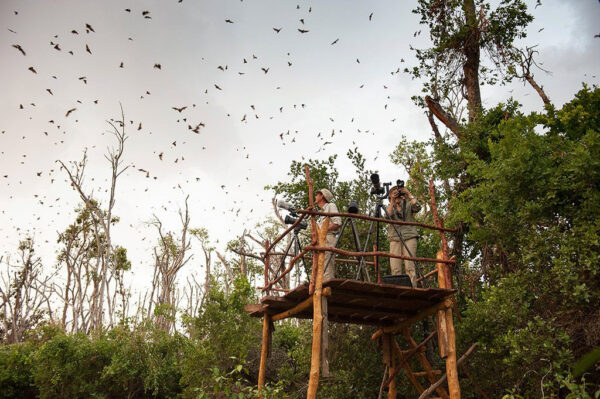
Right now, in a patch of swamp forest smaller than most Lusaka suburbs, the largest gathering of mammals on Earth is at its peak. Between October and December each year, up to an estimated 10 million straw-coloured fruit bats converge on a small area of evergreen mushitu forest in Kasanka National Park — and mid-November is the height of it. This weekend is, by the calendar, as good as it gets.
The Kasanka Trust, which has managed the park since 1986 in partnership with the Department of National Parks and Wildlife, describes the seasonal colony as possibly the largest concentration of mammals known in the world, according to the Zambia Tourism Agency. National Geographic, which has covered the migration since 2015, puts the figure at eight to ten million bats, with the peak in mid-November. The honest way to say it is that nobody has counted them one by one: the colony is an estimated eight to ten million, and the spectacle is the point, not the precise headcount.
The bats — Eidolon helvum, pale tawny animals with bright orange necks and a wingspan of up to about a metre — arrive from across Central Africa, including the Congo Basin, to feed on ripening wild fruit: musuku, waterberry, mufinsa, mahogany pods and mangoes, with the first rains. GPS tagging by the Max Planck Institute has shown some travelling thousands of kilometres, among the longest mammal migration routes in Africa, according to the Kasanka research summarised by Africa Geographic. Each night they fly tens of kilometres from the roost to feed.
The show happens twice a day. At dusk, the bats pour out of the forest in a stream that takes about 25 minutes to empty the roost, according to the Kasanka Trust — thousands becoming millions, the sky filling above the trees to the sound of wings and calls. At dawn they come back. The famous Fibwe hide, a treetop platform built high in a tall red mahogany on the edge of the Kapabi swamp, looks straight over the roost, and the shy sitatunga antelope can often be seen in the swamp below. The bats also draw predators — fish eagles and martial eagles hunt them — so the whole park is alive in November, not just the sky.
The catch: both lodges are closed this season
Here is the part that matters if you are planning to go. Wasa Lodge, the park's main lodge on Lake Wasa, is closed for the 2026 season, the Zambia Tourism Agency confirmed on 11 September 2026. Luwombwa Lodge, on the Luwombwa River in the west of the park, is also currently closed while management arrangements in the park are resolved, according to the safari operator Expert Africa, which says it has no confirmed reopening date. Do not book either one, and do not trust any website still listing their old rates.
What is open is a single, small operation. Everwild has confirmed that its semi-permanent bushcamp in Kasanka will operate for the 2026 bat migration season, hosting guests from 25 October to 1 December 2026, with the go-ahead from both the Kasanka Trust and the Department of National Parks and Wildlife, the Zambia Tourism Agency reported on 11 September. The camp is fully self-sufficient, has repaired the bat hides, and is maintaining the access road and airstrip. Alternative arrangements have been made for guests who had originally planned to stay at Wasa Lodge.
There are only six guest tents. That is the whole capacity of the park's accommodation this season. No nightly rate for the Everwild camp was published in any source we could find — so we are not printing one. If you want to go, contact Everwild or the Kasanka Trust directly for the price and availability, and do it soon: with six tents and the migration at its peak, the season will sell out.
Getting there, and what it costs at the gate
Kasanka is about 520 kilometres north of Lusaka, in Chitambo and Serenje districts of Central Province, on the south-western edge of the Bangweulu wetlands. The route is the Great North Road via Kabwe, Kapiri Mposhi and Serenje, then a turn towards Mansa and Samfya, with the park gate roughly 55 kilometres from that turn-off, according to the Kasanka Trust's directions. Published drive times disagree — the Trust's own site says about five hours in one place and about seven in another, while other operators say six to nine hours — so treat it as a full day's drive of six to nine hours depending on conditions, and take a 4x4 in the rains. Many visitors break the journey overnight. By air, charter flights run from Lusaka to Mulembo airstrip inside the park in about an hour and a half, according to the Kasanka Trust, and SkyTrails operates charters on the route this season. Everwild can arrange a private road transfer from Lusaka to Kasanka at US$750 per vehicle, the Zambia Tourism Agency reports.
Park entry fees, according to the Zambia Tourism Agency's official fee list, are K33.60 per person per day for Zambian citizens, US$7 for residents and SADC nationals, and US$10 for international visitors. Children under five enter free and children aged five to thirteen pay half. Camping is K42, or US$5, per person per day. One caution: a 2026 fee guide from the operator Khokelo Safaris lists the citizen rate as K25.20 rather than K33.60, so confirm the current fee with the park before you travel — fees change, and the gate is the final word.
Kasanka is one of Zambia's smallest parks, at about 390 square kilometres, and one of its least visited. That is part of the appeal: there are no queues at the hide, no crowds at the roost, just a forest, a platform, and ten million bats filling the evening sky. The migration is on now, and it will be gone by late December. The lodges may be closed, but the bats are not — and this weekend is the time to see them.