The Law Association of Zambia has taken a position on the question dominating Zambian politics — and it has picked the side of keeping the two-term limit. Its president, Arnold Kaluba, has said the association will defend the limit in Article 106 of the Constitution, and will take legal action if necessary to stop any attempt to remove it. News Diggers reported his remarks on Tuesday 17 November, according to the Lusaka Brief, which carried the story the same day. The Diggers report is behind a paywall, and the full text of the statement was not available.
Kaluba also urged members of Parliament to look beyond immediate political circumstances and to weigh the long-term effects of removing the limit on democracy, accountability and stability, the Lusaka Brief reported. And he welcomed the Justice Minister's assurance that the Executive will not interfere with the petitions before Parliament — a point that matters, because the petitions are where this fight now lives.
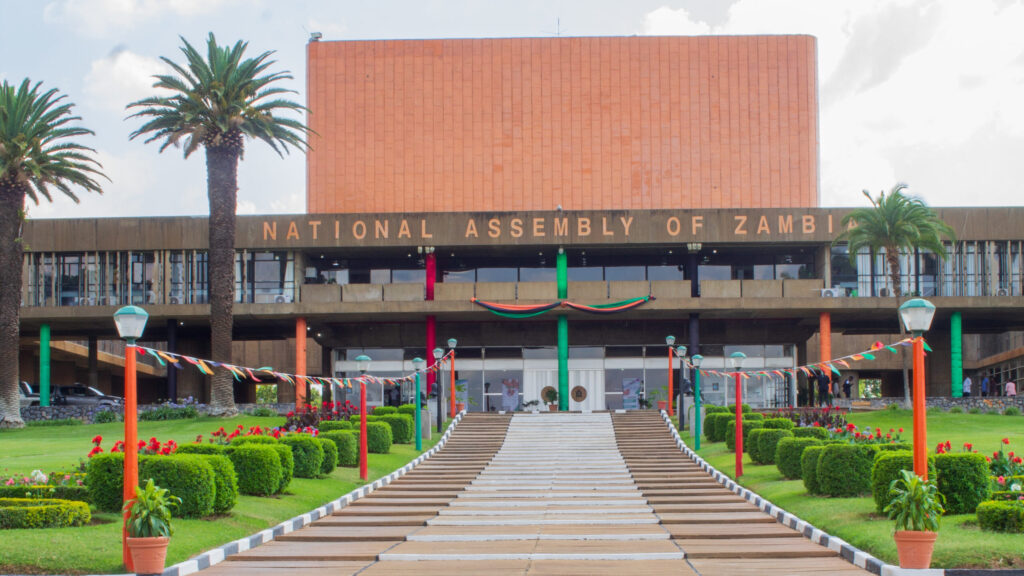
Three citizen petitions seeking to amend Article 106(3) — the clause that bars a person who has twice held office as President from being elected again — have been submitted to the National Assembly, Justice Minister Jack Mwiimbu told a Lusaka press briefing on Friday 13 November. No formal proposal to amend Article 106 has been tabled. What exists are the petitions, and a debate about what Parliament should do with them.
The lawyers' statement answers two requests made at the start of the month. On 2 November, the Zambia Monitor reported, Socialist Party president Fred M'membe wrote to the association asking it to convene an extraordinary general meeting on any amendment to Article 106 and to state its position within seven days. On 3 November, the Zambian Observer reported, three members — Linda Kasonde, the Chapter One Foundation executive director and a former LAZ president, Josiah Kalala and Henry Mulenga — lodged a formal requisition under the association's rules for an extraordinary meeting to adopt resolutions reaffirming a maximum of two five-year terms, opposing any extension and any application of a change to a sitting president, and authorising advocacy and litigation. The requisition recalled the association's part in the Oasis Forum that opposed a third term for Frederick Chiluba in 2001.
On the other side of the argument, a march is being planned. The Zambian Observer reported on Monday 16 November, crediting The People's Brief, that the Zambia Youth Organisation Consortium plans to march from Northmead bus station to the Parliament Buildings on Wednesday 25 November in support of removing the limit. The consortium's vice-chairperson, Boas Kanyama, said 63,151 young people from all ten provinces were expected, that the police had been formally notified and that about 500 officers were expected to provide security. Those numbers are the consortium's own: no other outlet had reported the plan by Tuesday morning, and they should be read as the organisers' claim, not as a confirmed turnout. Kanyama was quoted as saying: "As a consortium, we will not be reduced to a political party," adding that the march was about Zambians exercising a democratic right rather than about a third term.
The consortium is the body that presented a petition to Parliament on 28 October through nominated MP Francis Kope, according to the Zambia Monitor, and it first announced its request for a private member's motion on Article 106(3) in September.
M'membe responded to the march announcement the same evening, in an article published by the Zambian Observer. He called the plan "neither spontaneous nor organic" and a "calculated, state-sponsored assault on Zambia's constitutional order", asked who was funding it, and said young people should not be used as "cheap foot soldiers". He contrasted the police escort on offer with what he said were the difficulties opposition parties and civil society face in obtaining permits, repeated his call for a referendum on any change, and demanded that President Hakainde Hichilema "state clearly and publicly that he will neither seek nor accept a third term".
The government's position has not changed. Mwiimbu has said the petitions are a matter for Parliament and that the Executive will not interfere. State House, through Chief Communications Specialist Clayson Hamasaka, has said that the President neither initiated nor influenced the campaign: "This has nothing to do with the head of State, so why should he be dragged into it?" Opposition leader Given Lubinda has called for a national referendum. Wynter Kabimba of the Economic Front, in remarks reported by News Diggers on Monday, said removing the limit would be a bad idea and could split the governing UPND itself.
What happens next depends on the National Assembly, which has yet to say how or when the petitions will be dealt with, and on the Law Association, which has not said what form any litigation would take or at what stage it would be filed. The lawyers have spoken. The marchers are organising. Parliament has not yet said a word.