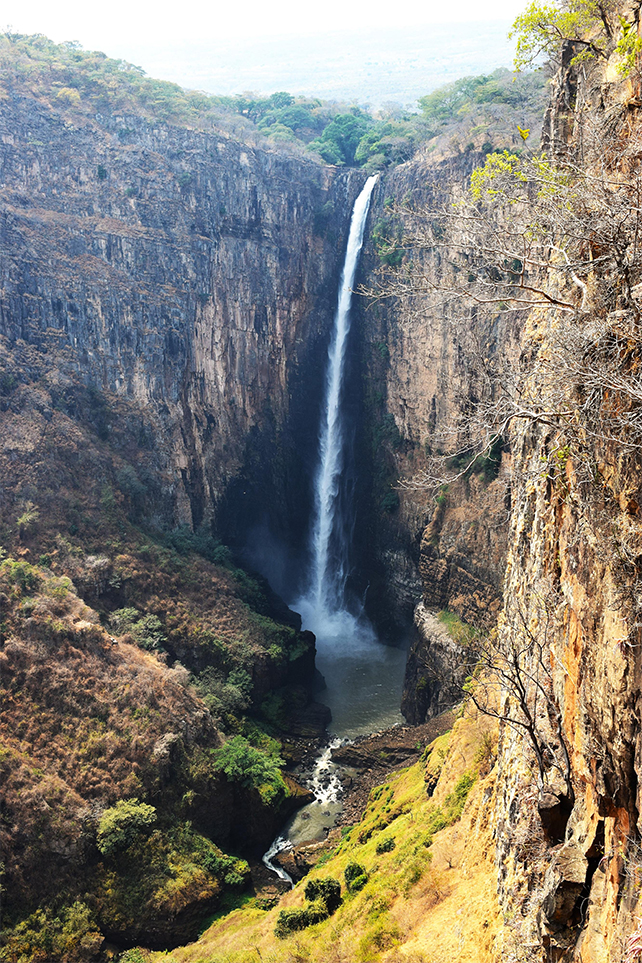
The road north does not hurry, and neither should you. From Lusaka it is roughly a thousand kilometres to Mbala, the old town at the top of the country that was once called Abercorn, and the reward for the long drive is the most overlooked corner of Zambia: the southern tip of Lake Tanganyika at Mpulungu, and Kalambo Falls, a single drop of water 221 metres high that is the second-tallest uninterrupted waterfall in Africa.
Kalambo is the headline, and it earns it. The falls plunge in one unbroken column from a cliff on the Zambian-Tanzanian border, 33 kilometres from Mbala, according to the Northern Province administration, and the World of Waterfalls guide lists the drop at 221 metres — nearly twice the height of Victoria Falls. The same guide notes the falls are the second-highest single drop on the continent and the twelfth-highest in the world. But the waterfall is not only tall; it is old in a way that rewrites history. Archaeologists working at the site found the earliest evidence yet of wooden structures built by humans — timber shaped and joined at least 476,000 years ago, according to the Tracks4Africa account of the dig, which the ScienceAlert report of the find also covered. People were building things at Kalambo before our own species existed.
There is a catch, and it is the season. The falls are at their fullest from March to June, when the rains have filled the river, according to the Africa Waterfalls guide, and by October the flow can be thin. November sits at the thin end of the year, so go expecting a graceful fall rather than a thundering one — and go in the morning, when the light is on the gorge. The Zambian viewpoint is reached by road from Mbala, about 35 kilometres on a rough track for which a four-wheel drive is essential, according to the same guide, and most travellers combine the falls with a stay at one of the lake lodges near Mpulungu.
The lake itself is the other half of the trip. Lake Tanganyika is Africa's longest lake, and it holds about 17 percent of the world's fresh water, according to the Nkwazi magazine account of the Kalambo Falls Lodge — a figure that stops you when you stand on the shore at Mpulungu, Zambia's only port on the lake, and look at water that runs north for more than 600 kilometres through four countries. Mpulungu is a working port, not a resort town: trucks and traders gather there to load the ships that cross to Tanzania, Burundi and the Democratic Republic of Congo. The most famous of them is the MV Liemba, the century-old ferry that once sailed as the German warship Graf von Götzen and has run a weekly service between Kigoma in Tanzania and Mpulungu for decades. She has been in refit since 2023 and began sea trials in mid-August 2026, according to Wikipedia's account of the vessel, with the Wikivoyage guide saying she was due back in service in September — but no sailing has been confirmed publicly since the trials, so do not plan a trip around her until a sailing is announced. Ask the Marine Services Company office in Kigoma first.
Getting to the far north is the practical question, and there are two honest answers. The quick one is to fly: Proflight Zambia flies Lusaka to Kasama six times a week, a flight of one hour and 35 minutes, according to the airline's own timetable — departing Lusaka at 10:25 and arriving at 12:00 on Mondays, Tuesdays, Thursdays, Saturdays and Sundays, with a Friday afternoon departure at 14:10. Fares are not published on that page, so check the airline's booking site before you count on it. From Kasama it is 167 kilometres to Mbala, according to the Lake Chila Lodge listing, a drive of roughly two and a half hours on the tarred road north.
The slow answer is the road all the way. The bus from Lusaka to Kasama covers 858 kilometres in about ten hours and ten minutes, according to the Rome2Rio timetable, with Juldan Motors running the route twice daily — and then it is the Kasama to Mbala leg on top. All told, the drive is about 1,025 kilometres and the best part of thirteen hours, which is why most travellers break it in Kasama. The road itself is tarred as far as Mbala; it is the last stretch to the falls, and the track to Nsumbu National Park, that need a high-clearance vehicle. Nsumbu, on the lake's south-western shore, is a boat ride away from the Kalambo lodges, according to the lodge listings, and worth the detour if you want game as well as water.
Where you sleep decides the budget, and the lake lodges are refreshingly plain about their prices. Kalambo Falls Lodge, forty minutes by boat from Mpulungu harbour, lists its all-inclusive rate at US$100 per person per night from 5 March to 20 December, rising to US$150 in the festive season, according to Zambia Resident Safaris — at the mid-market rate this morning, about K20.55 to the dollar, that is roughly K2,055 a night, or K3,083 at Christmas. The lodge's own site lists an off-season special of US$60 a night from 10 January to 31 March, self-catering at US$50, and camping and day visits at US$15. The rate covers three meals a day, the boat to and from Mpulungu harbour, fishing and snorkelling, and short trips to the neighbouring beaches; the guided hike to the falls is extra, with a government fee of K15 for Zambians and US$15 for non-Zambians, and a tip to the guide of at least K100, according to the same listing. A taxi transfer from Mbala costs K150 one way or K250 return, and cars can be parked at the Waterfront in Mpulungu at K40 a day. Boat hire for exploring the lake runs US$100 an hour. Children under twelve pay half and under-twos go free.
In Mbala town itself, Lake Chila Lodge sits on the lake of the same name and is listed as inexpensive with a 4.3-star rating from 56 reviews — a sensible base if you would rather sleep in town and drive out to the falls and the museum by day. The lodge can be reached on +260 977 795 241, according to its listing.
Do not leave Mbala without the museum. The Moto Moto Museum, one of Zambia's five national museums, opened in 1974 and takes its name from the French Catholic Bishop Joseph Dupont, nicknamed Moto Moto for his habit of smoking a pipe, according to the National Museums Board. Its collection began in the 1940s, when the Canadian priest Jean Jacques Corbeil started gathering the cultural artefacts of the people of Northern Province, and its halls cover archaeology from the Stone Age to the Iron Age, the ethnography of the province, and its political and social history. It is the quiet, indoor half of a trip that is mostly water and sky.
This is the second half of a journey we started last week, when the Culture Minister visited Kasama and said the Northern Circuit could help Zambia reach five million visitors a year — read our earlier piece on Kalambo, Chishimba and the Mwela rock art here: https://mainstream.zipangile.tech/articles/kalambo-chishimba-and-the-rock-art-of-mwela-the-north-s-three-wonders-are-waiting-for-roads. The wonders are already there. What the north needs is visitors willing to make the drive — and now, with six flights a week to Kasama, the drive is shorter than it has ever been.